


Table of Content
Companies are always striving to improve how they operate. They use performance indicators to gauge their company’s success.
In the business world, facing fierce competition, constant market changes, and the rapid introduction of new technologies is a challenge for a company. On top of that, business customers are increasingly demanding. To navigate these challenges, companies need to perform at their best consistently.
Running a successful business involves having a clear strategy and a set of rules to guide the organization forward towards long-term success. Management is structured into three levels: strategic, tactical, and operational. These levels work together as a powerful force to steer the current operations of the company in the right direction.
Understanding these management levels is crucial for any company with a strategy to adapt effectively to both its internal and external environment. The combination of strategic, tactical, and operational risk management is essential for maintaining a competitive edge.
Difference Between Strategic, Tactical and Operational Decisions
Management involves several key activities: planning, organizing, directing, and controlling the organizational processes. These activities are essential for achieving the goals set by an organization. Each level of management comes with its own responsibilities and specific functions.
Successfully implementing Smart Management 4.0 requires a solid grasp of the concepts of “Strategic,” “Tactical,” and “Operational” management. This understanding is crucial for developing a comprehensive plan that takes into account all three factors.
Each of these management levels plays a unique role, and by considering them collectively, you can create a more effective overall strategy and well-rounded approach to Smart Management 4.0.
Strategic Planning
A Strategic Plan serves as a bird’s-eye view of the entire business, outlining its vision, objectives, and values.
This plan forms the core foundation of the organization, guiding long-term decisions. Key elements include the vision, mission, and values of the entire business.
In the realm of operational manager strategic management, key responsibilities, operational activities and objectives encompass:
- Establishing the vision, mission, and goals.
- Formulating a strategy to achieve these goals.
- Allocating resources for strategy implementation.
- Analyzing the market and competition to adapt the strategy as necessary.
- Evaluating business performance and identifying opportunities for enhancement.
- Making strategic decisions that align with long-term vision and performance.
Tools at the strategic level include:
- Environmental analysis: Using the PESTEL method to assess political, economic, societal, technological, ecological, and legal forces.
- Competitive analysis: Assessing competitive forces to discern opportunities and threats.
- Analysis of company resources and capabilities: Identifying strengths and weaknesses.
- Analysis of the business portfolio: Utilizing tools like the BCG matrix or GE matrix.
- Strategic planning: Employing techniques such as managing schedules and task distribution to achieve set objectives.
Tactical Planning
A tactical plan details the specific tactics the organization intends to employ to fulfill the aspirations outlined in the strategic plan.
Typically spanning a time horizon of a year or less, this plan dissects the various parts of the strategic goals into more manageable and actionable components. It includes specific goals with defined deadlines, budget considerations, and resource allocations.
- The responsibilities and objectives of tactical management encompass:
- Planning and allocating resources.
- Overseeing and coordinating day-to-day activities to ensure the achievement of short-term goals.
- Communicating instructions and objectives to teams.
- Assessing operational performance and pinpointing opportunities for improvement.
Tools at the most tactical strategic, operational-tactical level involve:
- Short- or medium-term operational planning: Utilizing the SMART objectives methodology.
- Budgeting and cost tracking: Managing financial resources effectively.
- Performance evaluation: Assessing how well objectives are met.
- Process analysis: Identifying and enhancing processes to improve efficiency and quality.
- Establishing quality assurance systems: Ensuring the quality of products or services.
- Human resources management: Handling recruitment, training, and personnel management.
Operational Planning
An operational plan outlines the day-to-day operations of the company, providing a practical roadmap to achieve tactical goals within a realistic timeframe. This plan is highly specific, emphasizing short-term objectives, including policies developed, rules developed, and procedures.
The objectives of the organization forward current operations and operational management involve:
- Increasing productivity and profitability.
- Reducing costs and production times.
- Optimizing the utilization of human, financial, and material resources.
- Meeting the needs and expectations of employees.
- Anticipating and managing potential risks.
Tools at the highest level of the operational control level include:
- Definition and improvement of organizational processes and methods: Ensuring efficiency in day-to-day operations.
- Identification of needs: Recognizing what resources are required.
- Supply chain management: Coordinating the flow of goods and services.
- Performance indicators: Tracking and measuring progress.
- Stock management: Efficient handling of inventory.
- Tools for monitoring and evaluating individual performance: Assessing the performance of individuals within the organization.
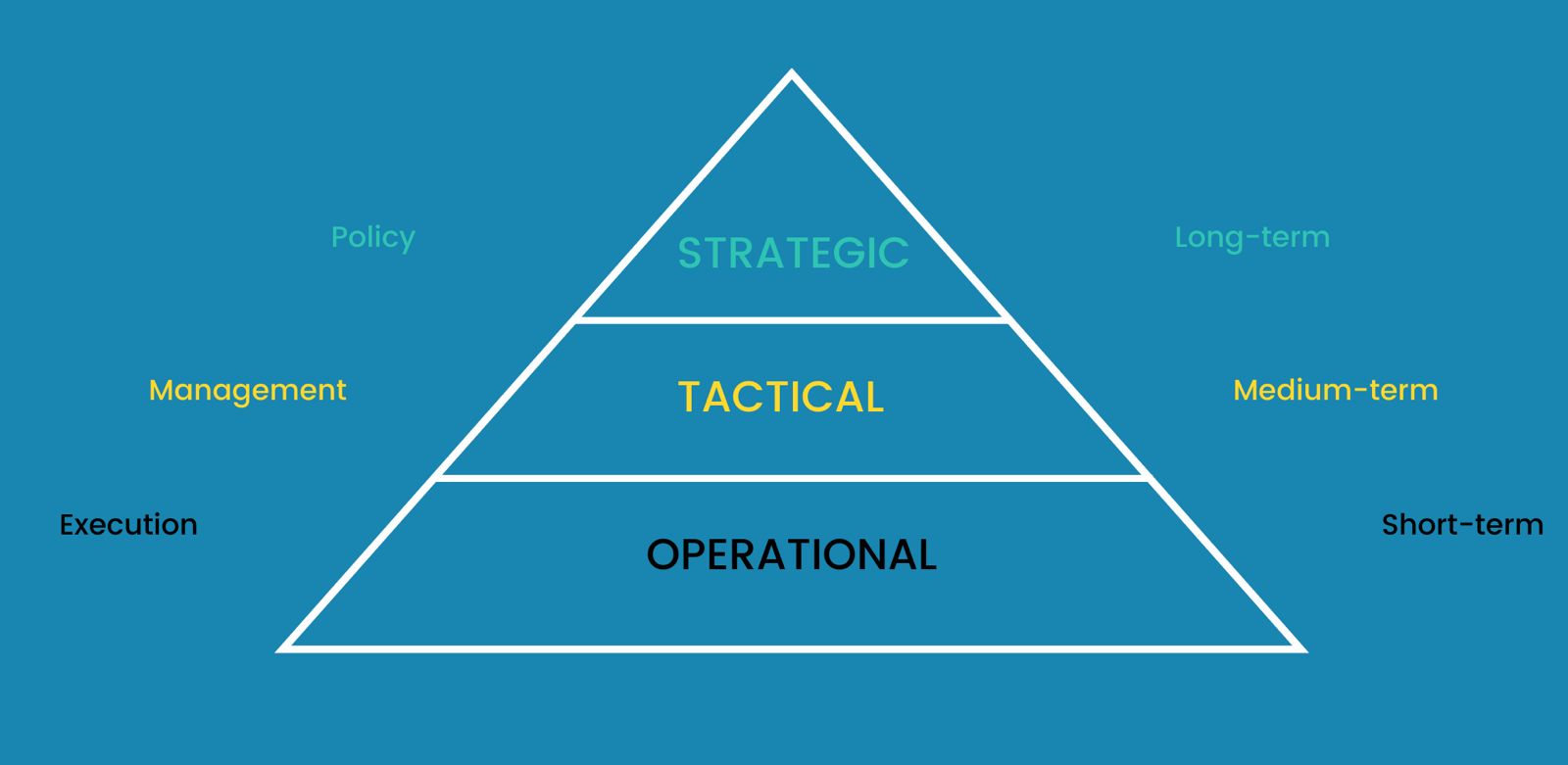
Strategic vs Tactical:
Strategic
1. Scope and time frame:
- Scope: Strategic planning is broad and focuses on the entire organization.
- Timeframe: Long-term perspective, typically covering several years.
2. Objectives:
- Nature: Concerned with defining the overall direction and purpose of the organization.
- Goals: Sets high-level, overarching goals to guide the company.
3. Decision Making:
- Level: Executed by top-level management, such as CEOs and top executives.
- Impact: Decisions have a significant and lasting impact on the organization.
4. Examples:
- Developing the company’s mission and vision.
- Deciding on entering new markets or launching new product lines.
Tactical:
- Scope and time frame
- Scope: Tactical planning is narrower and addresses specific areas or departments.
- Timeframe: Medium-term perspective, usually covering one to three years.
2. Objectives:
- Nature: Concerned with how to achieve the strategic goals.
- Goals: Break down the strategic goals into smaller, actionable steps.
3. Decision Making:
- Level: Involves middle-level management, such as department heads and managers.
- Impact: Decisions are more immediate and focus on the efficient execution of plans.
4. Examples:
- Allocating resources for specific projects.
- Implementing marketing strategies to achieve sales targets.
Operational vs Strategic
Operational and strategic are distinct and different levels of management that serve different purposes within an organization. Here’s a breakdown of the key differences between operational activities and strategic aspects:
Strategic:
1. Scope and Timeframe:
- Scope: Concerned with the overall direction and long-term goals of the organization.
- Timeframe: Involves planning for the future, often spanning several years.
2. Objectives:
- Nature: Focused on shaping the organization’s mission, vision, and competitive positioning.
- Goals: Sets high-level, fundamental objectives that guide the entire organization.
3. Decision Making:
- Level: Strategic decisions are made at the highest levels of management, typically by top executives.
- Impact: These decisions have a profound and lasting impact on the organization.
4. Examples:
- Entering new markets
- Developing new products or services
- Establishing long-term partnerships
Operational:
1. Scope and Timeframe:
- Scope: Concerned with the day-to-day activities and processes that keep the organization running.
- Timeframe: Involves short-term planning, often focusing on a daily, weekly, or monthly basis.
2. Objectives:
- Nature: Concentrates on the efficient execution of tasks to achieve strategic goals.
- Goals: Set specific, measurable, and short-term objectives that support the strategic plan.
3. Decision Making:
- Level: Operational decisions are made by front-line managers and employees responsible for daily operations.
- Impact: These decisions have an immediate impact on the efficiency and effectiveness of daily tasks.
4. Examples:
- Managing inventory levels
- Implementing production schedules
- Handling customer service inquiries

Tactical vs Operational
Tactical and operational are two distinct levels of planning and decision-making within an organization, each with its own focus overall strategy and time horizon. Here’s a breakdown of the key differences between tactical and operational plan aspects:
Tactical:
- Scope and time frame:
- Scope: Tactical planning is more focused than strategic planning, addressing specific areas or departments.
- Timeframe: Involves medium-term planning, typically covering one to three years.
- Objectives:
- Nature: Concerned with how to implement the broader strategic goals.
- Goals: Break down strategic goals into smaller, actionable steps.
- Decision making:
- Level: Tactical decisions are made by middle-level management, such as department heads and managers.
- Impact: These decisions have a moderate impact on the organization and are more immediate than strategic decisions.
- Examples:
- Allocating resources for specific projects.
- Developing marketing strategies for a product line.
Operational:
- Scope and time frame:
- Scope: Operational planning deals with day-to-day activities and processes within specific departments.
- Timeframe: Involves short-term planning, often focusing on a daily, weekly, or monthly basis.
- Objectives:
- Nature: Concentrates on the efficient execution of tasks to achieve tactical goals.
- Goals: Sets specific, measurable, and short-term objectives that support tactical plans.
- Decision making:
- Level: Operational decisions are made at the front line by supervisors and employees responsible for daily operations.
- Impact: These decisions have an immediate impact on the efficiency and effectiveness of daily tasks.
- Examples:
- Managing inventory levels
- Implementing production schedules
- Handling customer service inquiries
Bottom line
Effective management within an organization involves a dynamic interplay between strategic, tactical control, and operational control levels.
Strategic management sets the overarching direction and long-term goals, while tactical management translates these goals into actionable plans for specific areas. Operational management then executes these plans on a day-to-day basis, ensuring the efficient functioning of the organization.

Anja Bosiok ist Marketing Managerin bei TimeTrack und schreibt seit über drei Jahren über Zeitmanagement, moderne Arbeitswelt und digitale HR-Prozesse. Sie studierte Journalismus (Bachelor) sowie Publizistik- und Kommunikationswissenschaft (Magister) und verbindet redaktionelle Präzision mit tiefem Produktverständnis. Zuvor war sie als Content Managerin bei TimeTrack tätig und begleitet seitdem die Themen rund um Arbeitszeiterfassung und Personalorganisation – von der gesetzlichen Grundlage bis zur praktischen Umsetzung im Unternehmensalltag.

