


Table of Contents
Imagine a river flowing steadily towards the horizon, carving its path through rocks and boulders, nourishing the surrounding flora and fauna. Now, imagine that river as the dynamic and complex flow of human resources within a company. In other words: the human resource flow.
Similar to a river, this flow is constantly changing, adapting to external factors, and shaping the landscape of the workplace.
A company’s human resource flow controls personnel mobility, organisational structure, and human resource management. The entire employment process, including onboarding, training, promotions, transfers, and retirement, falls under the umbrella of human resource flow.
Definition
The processes of employee recruitment, retention, and termination are collectively referred to as “human resource flow” within organisations. This term encompasses the procedures and actions involved in controlling human resource objectives, such as training, professional development, promotions, transfers, termination of employment, and retirement.
Effectively managing a company’s human resources to align with its strategic goals is the essence of HR flow. This involves selecting suitable candidates for the right job, providing the necessary training and development, and offering opportunities for career advancement. Efficient management of human resource flow can enhance employee retention, productivity, and engagement, ultimately benefiting the organisation.

Why is human resource flow important?
It’s fundamental to manage the flow of human resources for several reasons:
Attracting and keeping the best employees for the company is a critical component of human resource management. Companies should have a simplified process for finding and employing staff members with the necessary knowledge and expertise.
Human resource management includes determining training requirements and providing employees with the tools they need to advance their careers. As a result, everyone’s productivity and job satisfaction increases, and the organisation’s overall competitiveness improves.
Setting performance objectives for staff members and providing them with feedback are both part of managing the flow of human resources. This enhances results, identifies development opportunities, and inspires everyone to give their best.
Planning for the future by identifying prospective successors for essential roles within the business is also part of human resource management. This lessens the effect of turnover on the organisation’s performance and ensures a seamless transition when people leave the company.
Controlling the flow of human resources entails fostering a healthy work environment and offering chances for professional development. In turn, this enhances organisational performance and lowers the cost of turnover by increasing employee engagement and retention.
Key elements of human resource flow
Recruitment
The initial phase of the flow of human resources is recruitment. It entails sourcing the best applicants for specific employment opportunities. There are several ways to recruit people, including job boards, recommendations, social media, and headhunting.
Only those qualified for the position and who mesh well with the organisation’s culture should be hired. The following steps should be included in the recruiting process to accomplish this:
- Job analysis to determine the abilities, information, task significance and expertise needed for a specific employment role.
- Use job boards, social media, and personal recommendations, to find the best candidates.
- Assess CVs, conduct interviews and background checks to find the best applicants.
- Choose candidates who would fit well into the company culture.
Onboarding
The process of integrating new hires into a company is known as onboarding. This step ensures that new hires fit seamlessly into the organisation’s culture, rules and processes and develop into helpful team members. The following phases are often included in onboarding:
- Orientation entails explaining the corporate objectives, beliefs, and objectives to the new employee.
- During training, new hires are given the skills and information to successfully carry out their job duties.
- Introduction to the team: This entails introducing the new employee to other vital stakeholders in the company as well as members of their team.
A little help with HR Reporting
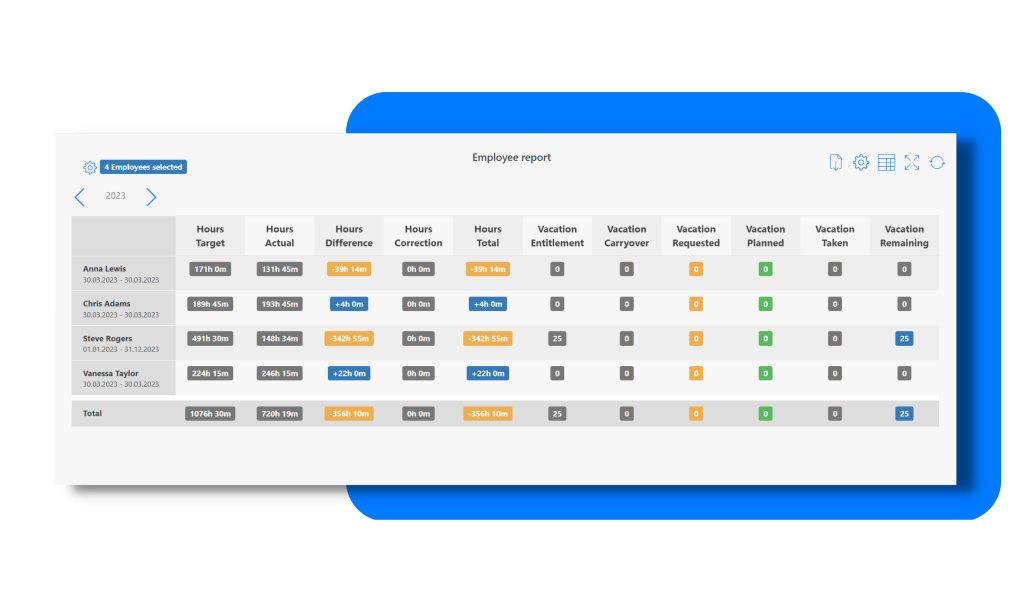
HR managers can benefit greatly from detailed HR Reporting, as it provides comprehensive data on various aspects of their employees. This data includes targeted hours, actual hours worked, hours differences and corrections, total hours, vacation entitlement and carryover, as well as requested, planned, and taken vacation time.
With access to this information, HR professionals can make informed decisions regarding employee scheduling, overtime pay, and vacation policies. The data allows them to track employee performance, identify areas where improvements can be made, and manage employee leave effectively.
Overall, detailed HR Reporting is an essential tool for HR managers to keep track of their workforce and ensure that their company is operating smoothly and efficiently.
Performance administration
Employee performance is evaluated and improved via the process of performance management.
This includes establishing performance objectives, job satisfaction, offering criticism, and pinpointing improvement areas. Performance management is essential for ensuring that employees are efficient and supportive of the organisation’s goals.
The following steps are often included in performance management:
- Establishing goals entails establishing precise performance objectives that align with the companies.
- Frequent feedback on an employee’s performance, emphasising their strengths and weaknesses, is known as performance feedback.
- Performance improvement is about identifying areas that need improvement and creating plans of action to boost worker performance.

Employee development
Career development involves assisting individuals in enhancing their careers inside the business by developing their skills, task identity, knowledge, and experience.
Career development is essential for retaining top talent and ensuring that employees are engaged and motivated to reach their professional objectives.
The following phases are often included in career development:
- Career planning involves working with staff members to determine their professional objectives and create a strategy to achieve them.
- Training, mentorship and work shadowing are all methods of skill development that employers use to provide their staff members with the chance to advance their knowledge and abilities.
- The company rotates workers through several job roles to diversify an employee’s experience and skillset.
Transition planning
The company identifies and develops possible future leaders through the succession planning process. To ensure a pipeline of suitable candidates for important jobs in the future, succession planning is essential. Succession planning typically includes the following steps:
- Identify the critical roles that require filling.
- Spot and cultivate prospective future leaders through instruction, mentorship, and work rotations as part of talent development.
The process of preparing for a seamless transfer of individuals into essential roles within a company is known as transition planning.
Retention
Retaining excellent personnel within a company is known as employee retention. It is important for a firm to maintain a reliable and productive workforce. The following steps are typically involved in employee retention:
- Fostering employee engagement to create a stimulating, demanding, and rewarding work environment.
- Offering competitive compensation and benefit plans to attract and keep top talent.
- Encouraging a healthy work-life balance by providing flexible work options, such as telecommuting and flexible scheduling.
Exit management
Departure management is controlling an employee’s exit from the company. To preserve a good working relationship with exiting employees and to keep corporate operations running smoothly, exit management is essential.
The following steps are often included in exit management:
- Conducting exit interviews with departing workers is one way to learn about their reasons for doing so and find areas where they may improve.
- Knowledge transfer is ensuring that leaving workers pass on their knowledge and skills to other team members.
- Offboarding entails the formalities involved in an employee’s termination, such as returning business property and rescinding access to corporate networks.
Conclusion
A vital component of every organisation’s success is the flow of its human resources. This entails controlling employee mobility inside a company from hiring through firing.
The entire employment process, including onboarding, training, promotions, transfers and retirement, is covered by human resource flow. Organisations can recruit and retain top talent, groom future leaders, and maintain a high-performing workforce by managing the flow of human resources well.

Anja Bosiok ist Marketing Managerin bei TimeTrack und schreibt seit über drei Jahren über Zeitmanagement, moderne Arbeitswelt und digitale HR-Prozesse. Sie studierte Journalismus (Bachelor) sowie Publizistik- und Kommunikationswissenschaft (Magister) und verbindet redaktionelle Präzision mit tiefem Produktverständnis. Zuvor war sie als Content Managerin bei TimeTrack tätig und begleitet seitdem die Themen rund um Arbeitszeiterfassung und Personalorganisation – von der gesetzlichen Grundlage bis zur praktischen Umsetzung im Unternehmensalltag.

