


Strategic planning is the process of establishing an organisation’s strategic goals and objectives. It involves analysing the external environment, identifying opportunities and hazards, and defining the organisation’s vision, corporate objectives, mission, and values. Strategic planning provides a road map for the organisation’s future and guides all performance management activities.
Table of Contents
Organisations strive to maintain a competitive advantage in today’s evolving business environment. Effective strategic performance management is a key technique for achieving this objective. Strategic performance management (SPM) is an all-encompassing approach to managing organisational performance, from the individual employee level to the enterprise as a whole.
Definition
Strategic performance management (SPM) is the planning, monitoring, and evaluating of an organisation’s performance; relative to its strategic goals and objectives.
It’s an approach that integrates the performance of employees, teams, and business entities with the organisation’s strategy. SPM combines performance management and strategy execution to ensure the organisation is heading in the correct direction and attaining its goals.
SPM provides a structured framework for managing performance at all organisational levels. It allows businesses to concentrate on the critical success factors and key performance indicators that drive successful business results. SPM also enables organisations to identify areas for development and optimise performance based on data-driven decisions.

Why is strategic performance management essential?
Organisations that want to accomplish their strategic objectives and remain ahead of the competition must implement SPM.
An advantage of SPM is its structured framework for managing performance at all organisational levels. This facilitates the dismantling of organisational silos and the improvement of collaboration and communication across departments and teams. By aligning performance with strategic objectives, SPM enables employees to better comprehend their duties and responsibilities and ensures everyone is working towards the same goal.
SPM enhances collaboration, communication, and cooperation by ensuring everyone achieves the same aims and objectives.
SPM provides clarity regarding employee and team expectations. It establishes distinct company goals and objectives, making it simpler for employees to comprehend their roles and responsibilities. It also helps HR professionals get a clear idea of the company goals and plan human resources accordingly.
Continuous improvement
Strategic performance management enables organisations to review performance, identify improvement opportunities and implement corrections. It allows organisations to continuously monitor and optimise performance based on data-driven decisions.
SPM establishes a culture of continuous feedback and accountability by establishing defined performance expectations and holding employees and teams accountable for meeting them.
SPM offers organisations a competitive advantage by enabling them to concentrate on their critical success factors. It allows businesses to distinguish themselves from rivals by delivering superior performance.
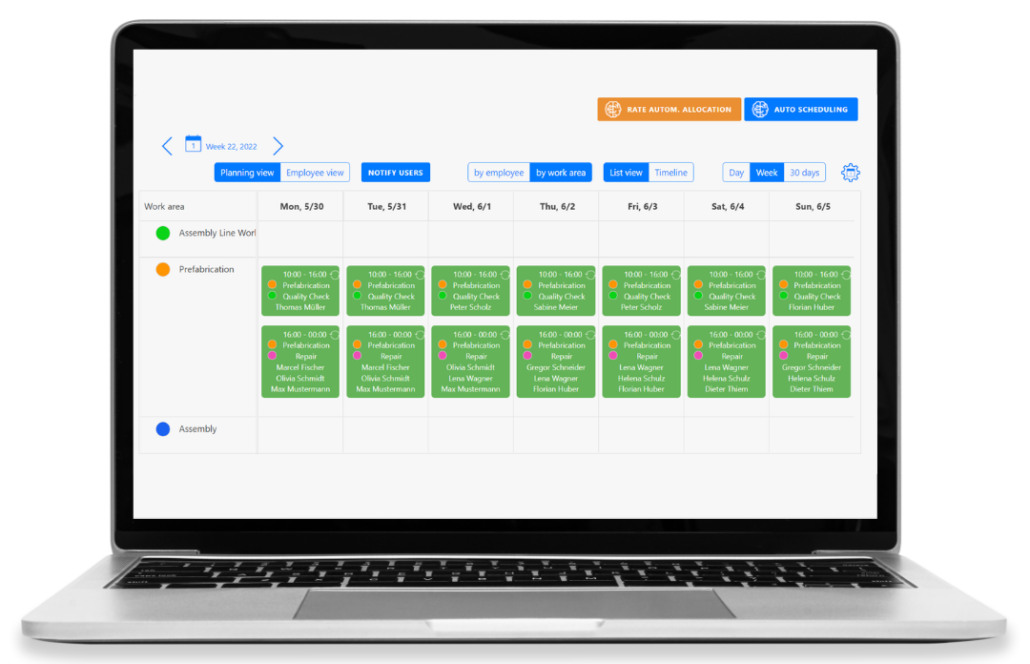
Manage performance with accurate employee schedules
Part of strategic performance management involves keeping a close eye on your team’s schedules and absences.
Keeping track of and monitoring the wants of all employees is time-consuming. Here, TimeTrack takes on all the effort for you!
A column with a grey background is promptly added to the shift plan whenever the system approves an absence. This increases the company’s transparency and prevents planning errors.
The flexible time-tracking software lets you note your performance and absences from anywhere and anytime. Input your working hours or availability using your smartphone’s mobile app, web app, or terminal app.
5 elements of strategic performance management
SPM consists of five essential components for achieving success. These include:

Performance evaluation in strategic management
Measuring the success of strategic performance management calls for a balanced approach that considers financial and non-financial measures.
Financial metrics are the measurements of financial performance that relate to an organisation’s strategic objectives. These metrics may include revenue growth, profitability, ROI and cashflow. Financial metrics clearly indicate a company’s capacity to generate shareholder value.
Customer metrics evaluate customer loyalty and satisfaction parameters. This information provides insight into an organisation or employee’s performance and capacity to provide value to consumers.
Operational metrics measure the efficacy and effectiveness of the processes and systems of an organisation. These may include cycle time, output, quality, and process optimisation. Operational metrics provide insight into an organisation’s capacity to efficiently and effectively deliver its products or services.
Employee metrics measure employee engagement, satisfaction, and productivity. These may include employee satisfaction ratings, turnover, and productivity measurements. Metrics regarding personnel provide insight into an organisation’s capacity to recruit, retain, and develop its workforce.
Innovation metrics assess an organisation’s ability to innovate and adapt to fluctuating market conditions. These include the new products or services introduced, the proportion of revenue derived from new products, and the number of patents or trademarks lodged. Metrics for innovation provide insight into a company’s capacity to remain ahead of the competition.
Tip
Rewarding achievements involves recognising and rewarding the performance of employees based on their results and behaviours. Praise, recognition, bonuses, promotions, or career opportunities, can be intrinsic or extrinsic. Rewarding achievements help to motivate employees, reinforce desired behaviours, and increase satisfaction and retention.
The importance of strategic performance management
Strategic performance management is a powerful tool that can help organisations achieve their goals, stand out from competitors, and remain sustainable. Here are some benefits of strategic performance management:
- By aligning employees’ and managers’ expectations with the company’s strategy and values, a shared understanding and commitment is created amongst all stakeholders.
- Using various indicators and metrics, companies can monitor and evaluate its progress against strategic goals and objectives. This helps identify strengths, weaknesses, opportunities, and threats and allows timely adjustments.
- Encouraging employees and managers to seek feedback, learn from their mistakes, and develop their skills and competencies enhances product quality and innovation, and improves efficiency and effectiveness.
- Recognising and appreciating employee and manager contributions based on their results and behaviours incentivises better performance, boosts satisfaction, engagement, and retention.
Strategic performance management calls for involvement and collaboration at all levels. It demands a clear vision and strategy, supportive culture and structure, reliable measurement system, and fair reward system.
Conclusion
Strategic performance management is indispensable for any business that wants to remain relevant and competitive. Organisations can enhance collaboration, communication, and cooperation at all levels by aligning performance with strategic objectives, monitoring progress, and continuous enhancments through data-driven decision-making.
SPM enables stakeholders to adequately understand an organisation’s performance, which is essential for making informed decisions and taking corrective action as required.
Companies can differentiate themselves and deliver superior performance by incorporating the five main elements of SPM – financial, customer, operational, and employee development, and innovation metrics.
Strategic performance management is the key to unlocking maximum potential and attaining your strategic objectives, regardless of the size of your organisation.

Anja Bosiok ist Marketing Managerin bei TimeTrack und schreibt seit über drei Jahren über Zeitmanagement, moderne Arbeitswelt und digitale HR-Prozesse. Sie studierte Journalismus (Bachelor) sowie Publizistik- und Kommunikationswissenschaft (Magister) und verbindet redaktionelle Präzision mit tiefem Produktverständnis. Zuvor war sie als Content Managerin bei TimeTrack tätig und begleitet seitdem die Themen rund um Arbeitszeiterfassung und Personalorganisation – von der gesetzlichen Grundlage bis zur praktischen Umsetzung im Unternehmensalltag.

